Green Lasers and Astrophotography

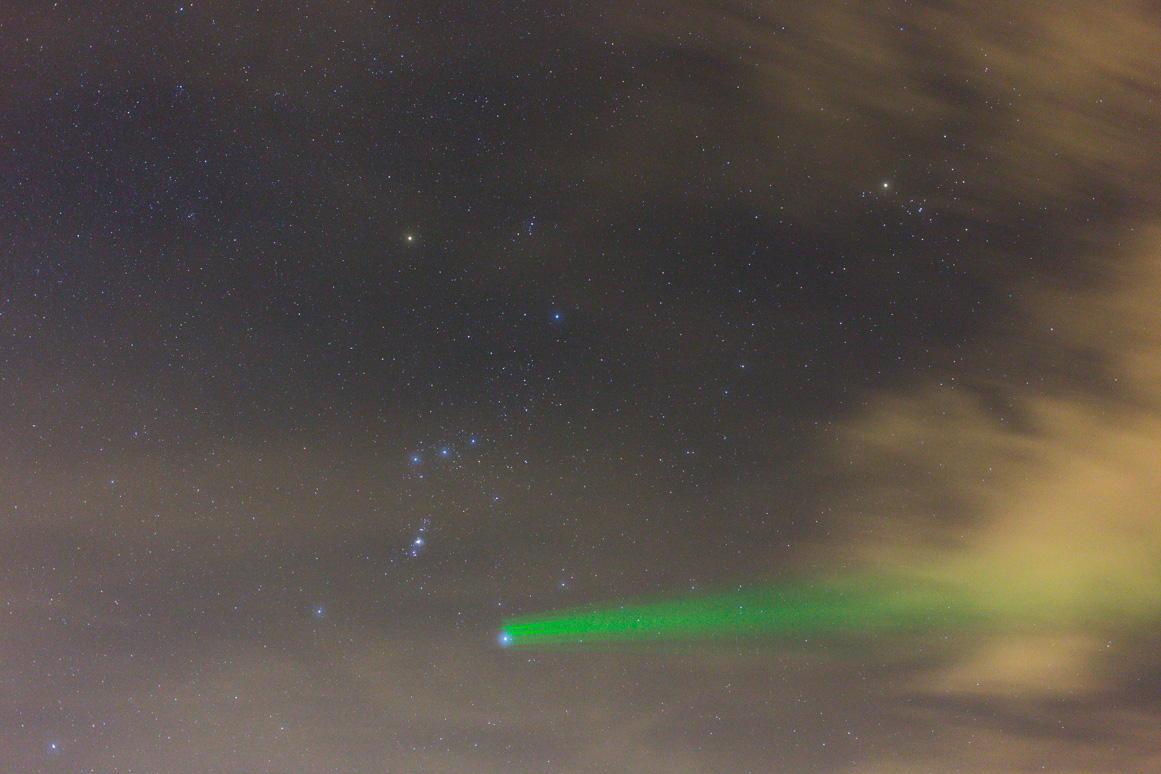
A couple months ago I was playing around with a green laser, typically used by amateur astronomers to point out celestial objects to others,  and decided to photograph it in use to see how it would show in a photograph.  Honestly, this wasn’t high on my list of things to do but I was clouded out so thought I’d have some fun.  This is a typical untracked exposure length of 15 seconds at f/4 with a 40mm focal length.  I aimed the green laser at Rigel and tried to hold it steady for the duration of the 15 second exposure.  So, this is worst case scenario for the laser being continuously on and pointed at a single object for the duration of the exposure.  That’s not to belittle the impact that green lasers have on us imagers; a quick pass through our image might not be obvious in the final image but lingering on an object for a while might be the difference between a good 20 minute exposure and one that’s going in the trash.  I’ve been lucky enough that I haven’t had an image that was obviously ruined by a laser but then again it’s hard to tell; I’ve had bad glare that may have resulted from errant green lasers playing over my equipment….


IMG_2439
Green laser aimed at Rigel


Observatory Site Clearing Update 6/19/2016

Site clearing is now well underway with a backhoe rental.  Most of the site is now cleared and a new, more drive-able, road is in place to get to the site.  Lots of clean up and grading to do but we’re getting there.

Tennessee Spring Star Party 2016 – Fall Creek Falls

M63 - Close Up
Galaxy M63 – Close Up
M63 - AP900GTO, Stellarvue SVQ-100, Apogee Ascent A694, Baader LRGB Filters, 4.5 Hour Total Exposure TIme.
M63 – AP900GTO, Stellarvue SVQ-100, Apogee Ascent A694, Baader LRGB Filters, 4.5 Hour Total Exposure Time.


M63 - Annotated
M63 – Annotated

Messier 63 (also known as M63, NGC 5055, or the Sunflower Galaxy) is a spiral galaxy in the constellation Canes Venatici consisting of a central disc surrounded by many short spiral arm segments. M63 is part of the M51 Group, a group of galaxies that also includes M51 (the ‘Whirlpool Galaxy’). M63 is an active galaxy with a LINER nucleus.[3]

M63 was discovered by Pierre Méchain on June 14, 1779.[4] The galaxy was then listed by Charles Messier as object 63 in the Messier Catalogue.

In the mid-19th century, Lord Rosse identified spiral structures within the galaxy, making this one of the first galaxies in which such structure was identified.[4]

In 1971, a supernova with a magnitude of 11.8 appeared in one of the arms of M63.

Information courtesy of Wikipedia.


Tennessee Spring Star Party at Dusk
Sat Night had some thin clouds moving through


Friday night was fantastic without a cloud to be seen.  Saturday night was less pristine with a lot of thin cloud moving through.  I thought we had some clearing later but a lot of the images from Sat night showed very inconsistent background values which leads me to believe we had thin stuff moving through all night.  Still, how many clear nights can you ask for?  It was a great TSSP and looking forward to the Fall Star Party.

SQM measurements topped out around 21.3 on Friday night and 21.4 on Saturday night.